Article
Welcome to EyeICare
Article #6 : Behavioral optometry
6-March-2015

Behavioral optometry also known as functional optometry is an expanded area of optometric practice that uses a holistic approach to the treatment of vision and vision information processing problems. The practice of behavioral optometry incorporates various vision therapy methods and has been characterized as a complementary alternative medicine practice by the American Academy of Ophthalmology because they don't study this area of practice. The field has been subject to criticism because other than the Convergence Insufficiency Treatment Trial (CITT) there are few other gold standard level studies of its effectiveness, similar to surgical interventions (like surgery, therapy cannot be double blind in studies). The American Optometric Association has published a clinical guideline for the practice of vision therapy, the methods and techniques utilised in behavioural optometry. The report's author concludes "With the possible exception of educating some patients to interpret blurred retinal images more carefully and of convincing some others that they could see better even though there was no actual improvement, this study indicates that the visual training used on these patients was of no value for the treatment of myopia." A review of the data undertaken in 1991 by two behavioural optometrists and published in the Journal of Behavioural Optometry, concludes that there were statistically significant positive changes in visual acuity due to the exercises and that the original conclusion that myopia reduction vision training is ineffective is unfounded. Visual neuro-rehabilitation for congenital/developmental concerns as well as visual concerns related to trauma and pathology are well founded. A review in 2000 concluded that there were insufficient controlled studies of the approach and a 2008 review concluded that "a large majority of behavioural management approaches are not evidence-based, and thus cannot be advocated." There is some question as to the value of such assessments, as most behavioral domains, such as psychology and education do not lend well to the strict requirements of evidence-based medicine (EBM). Indeed, many common medical practices also have not been supported by EBM, such as off-label use of medications, or use of medication for learning and reading disabilities. Current science supports the clinical benefits of visual rehabilitation for many areas of concern, in particular post traumatic brain injury, vision-related learning and behavior concerns, balance, and transient disease conditions that affect visual alignment and control. The effect of visual neuro-rehabilitation and neurosensory integrative rehabilitation are wide-ranging and will impact on obvious visual processing concerns, but also with symptoms similar to cognitive, behavioral or language disorders such as ADHD and dyslexia.[citation needed] It is not uncommon for children with extreme visual dysfunction to go unnoticed, or diagnosed with other conditions. It is growing in popularity among parents who may not want their children to be stigmatized by being labeled with a cognitive or language impairment
Article #5 : Visual perception
7-March-2015
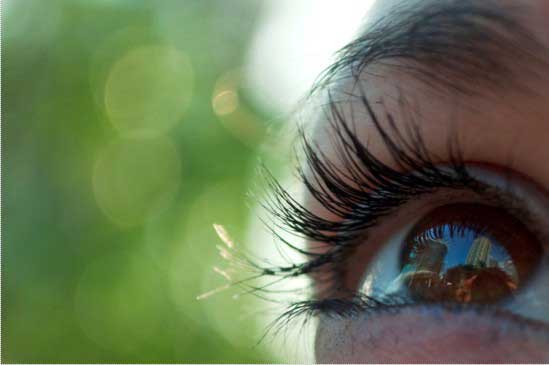
The visual system in animals allows individuals to assimilate information from their surroundings. The act of seeing starts when the lens of the eye focuses an image of its surroundings onto a light-sensitive membrane in the back of the eye, called the retina. The retina is actually part of the brain that is isolated to serve as a transducer for the conversion of patterns of light into neuronal signals. The lens of the eye focuses light on the photoreceptive cells of the retina, which detect the photons of light and respond by producing neural impulses. These signals are processed in a hierarchical fashion by different parts of the brain, from the retina upstream to central ganglia in the brain. Note that up until now much of the above paragraph could apply to octopi, mollusks, worms, insects and things more primitive; anything with a more concentrated nervous system and better eyes than say a jellyfish. However, the following applies to mammals generally and birds (in modified form): The retina in these more complex animals sends fibers (the optic nerve) to the lateral geniculate nucleus, to the primary and secondary visual cortex of the brain. Signals from the retina can also travel directly from the retina to the superior colliculus. The perception of objects and the totality of the visual scene is accomplished by the visual association cortex. The visual association cortex combines all sensory information perceived by the striate cortex which contains thousands of modules that are part of modular neural networks. The neurons in the striate cortex send axons to the extrastriate cortex, a region in the visual association cortex that surrounds the striate cortex.
Early studies: There were two major ancient Greek schools, providing a primitive explanation of how vision is carried out in the body. The first was the "emission theory" which maintained that vision occurs when rays emanate from the eyes and are intercepted by visual objects. If an object was seen directly it was by 'means of rays' coming out of the eyes and again falling on the object. A refracted image was, however, seen by 'means of rays' as well, which came out of the eyes, traversed through the air, and after refraction, fell on the visible object which was sighted as the result of the movement of the rays from the eye. This theory was championed by scholars like Euclid and Ptolemy and their followers. The second school advocated the so-called 'intro-mission' approach which sees vision as coming from something entering the eyes representative of the object. With its main propagators Aristotle, Galen and their followers, this theory seems to have some contact with modern theories of what vision really is, but it remained only a speculation lacking any experimental foundation. Both schools of thought relied upon the principle that "like is only known by like", and thus upon the notion that the eye was composed of some "internal fire" which interacted with the "external fire" of visible light and made vision possible. Plato makes this assertion in his dialogue Timaeus, as does Aristotle, in his De Sensu. The major problem with the Gestalt laws (and the Gestalt school generally) is that they are descriptive not explanatory. For example, one cannot explain how humans see continuous contours by simply stating that the brain "prefers good continuity". Computational models of vision have had more success in explaining visual phenomena and have largely superseded Gestalt theory. More recently, the computational models of visual perception have been developed for Virtual Reality systems these are closer to real life situation as they account for motion and activities which are prevalent in the real world.[citation needed] Regarding Gestalt influence on the study of visual perception, Bruce, Green & Georgeson conclude: