Article
Welcome to EyeICare
Article #10 : Scope of eye surgury Practice:
10-March-2015
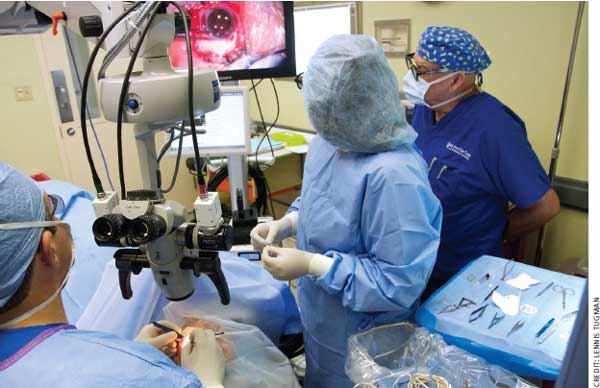
Within the healthcare system, optometrists function as primary eye care providers who are especially experienced in fitting contact lenses and glasses prescriptions. Opticians in America generally dispense corrective eyewear, and in some cases also construct the corrective eyewear. Optometrists can also treat their patients that have eye diseases with: Oral medications(such as antivirals, antibiotics, oral steroids and pain medications) Topical medications such as prescription eye drops to treat glaucoma or red eye. njectable medications. Optometrists may also be trained in some surgical techniques, including those for foreign body removal, corneal injury, eyelid & lacrimal disease, removal of "lumps and bumps" around the eyes and others. The scope of practice in optometry varies as it is regulated by each state. For example: In Oklahoma, the state optometry board also allows state-certified optometrists to perform surgeries limited to the anterior segment of the eye. In Kentucky, recent legislation permits Optometrists to perform a multitude of laser procedures. In many cases optometrists and ophthalmologists work together in the treatment and management of patients with various eye conditions.
Regulation: Doctors of optometry in the United States are currently regulated by state boards that determine their scope of practice, which may vary from state to state. The Association of Regulatory Boards of Optometry (ARBO) assists these state board licensing agencies in regulating the practice of optometry.
Representation: The American Optometric Association (AOA) represents optometrists nationally in the USA. Prior to admittance into optometry school, optometrists typically complete four years of undergraduate study, culminating in a bachelor’s degree. Required undergraduate coursework for pre-optometry students covers a variety of health, science and mathematics courses. These courses include: four semesters of chemistry to include organic and biochemistry, two semesters of physics and biology, as well as one semester of calculus, statistics, physiology, anatomy, microbiology, and psychology. Additional requirements are imposed by specific institutions. Once completing these courses, admission to an optometry doctorate program requires that candidates score well on the O.A.T., Optometry Admission Tests. There are currently 21 optometry schools in the United States, and admission into these schools is highly competitive.
Training: Optometrists are required to complete a four-year postgraduate degree program to earn their doctor of optometry (O.D.) titles. The four-year program includes classroom and clinical training in geometric, physical, physiological and ophthalmic optics, ocular anatomy, ocular disease, ocular pharmacology, neuroanatomy and neurophysiology of the vision system, binocular vision, color, form, space, movement and vision perception, design and modification of the visual environment, and vision performance and vision screening. In addition, an optometric education also includes a crash course of human anatomy, systemic diseases, general pharmacology, general pathology, microbiology, sensory and perceptual psychology, biochemistry, statistics and epidemiology. Upon completion of an accredited program in optometry, graduates hold the doctor of optometry degree. Optometrists must then pass a national examination administered by the National Board of Examiners in Optometry (NBEO). The three-part exam includes basic science, clinical science and patient care. (The structure and format of the NBEO exams are subject to change beginning in 2008.) Some optometrists go on to complete one- to two-year residencies with training in a specific sub-specialty such as pediatric eyecare, geriatric eyecare, specialty contact lens, ocular disease or neuro-optometry. All optometrists are required to fulfill continuing education requirements to stay current regarding the latest standards of care.
Article #9 : Eye examination
9-March-2015
Refraction
Refractive error is an optical abnormality of the eye in which a corrective lens is needed for proper focusing. Refraction is the procedure by which any refractive error is characterized and qualified. Refraction is a process your eye care professional uses to measure your refractive error, or vision problem. A refractive error is an optical defect that does not allow light to be brought into sharp focus on your retina, resulting in blurred or distorted vision. Examples of refractive error are myopia, hyperopia, and astigmatism. During a comprehensive eye examination, your eye care professional uses refraction to determine how much power is needed to bring your eyes to normal, perfectly focused vision. Your eye care professional will decide if glasses, contact lenses or laser vision correction will yield you the most clear eyesight. Refraction consists of two parts, objective and subjective. Objective Refraction: An objective refraction is a refraction obtained without receiving any feedback from the patient. An objective refraction is obtained by using different instruments. Your doctor will use a retinoscope or auto-refractor to measure your refraction without asking for subjective responses from you.
Retinoscopy: One of the most common instruments used for objective refraction is the retinoscope. Using a retinoscope, your doctor will project a streak of light into your pupil. A series of lenses are flashed in front of your eye. By looking through the retinoscope, your doctor can study the light reflex of the pupil. Based on the movement and orientation of this retinal reflection, the refractive state of your eye is measured.
Auto-refraction: Another instrument used for objective refraction is an auto-refractor. An auto-refractor is a computerized instrument that shines light into your eye. The light travels through the front part of your eye to the back part of your eye, then back again. The information bounces back to the instrument, giving an objective measurement of your refractive error. Auto-refractors are quick and easy to use, and require no feedback from you.
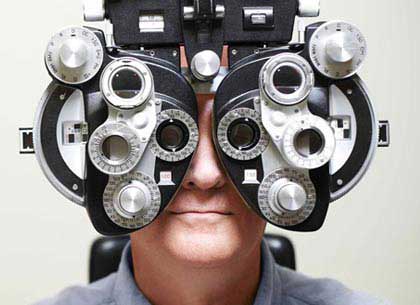
Subjective Refraction: A subjective refraction requires responses from the patient. Your eye care professional may use a phoropter or a trial frame to measure your subjective refractive error to determine your eyeglass prescription. Typically, you will sit behind the phoropter or wear a trial frame and look at an eye chart. Your eye care professional will change lenses and other settings while asking you for feedback on which set of lenses give you the best vision. Sometimes eye care professionals prefer to obtain a cycloplegic refraction, especially when trying to obtain an accurate refraction in young children who may skew refraction measurements by adjusting their eyes with accommodation. Cycloplegic eye drops are applied to the eye to temporarily paralyze the ciliary muscle of the eye.