Article
Welcome to EyeICare
Article #4 : Retinoscopy
4-March-2015
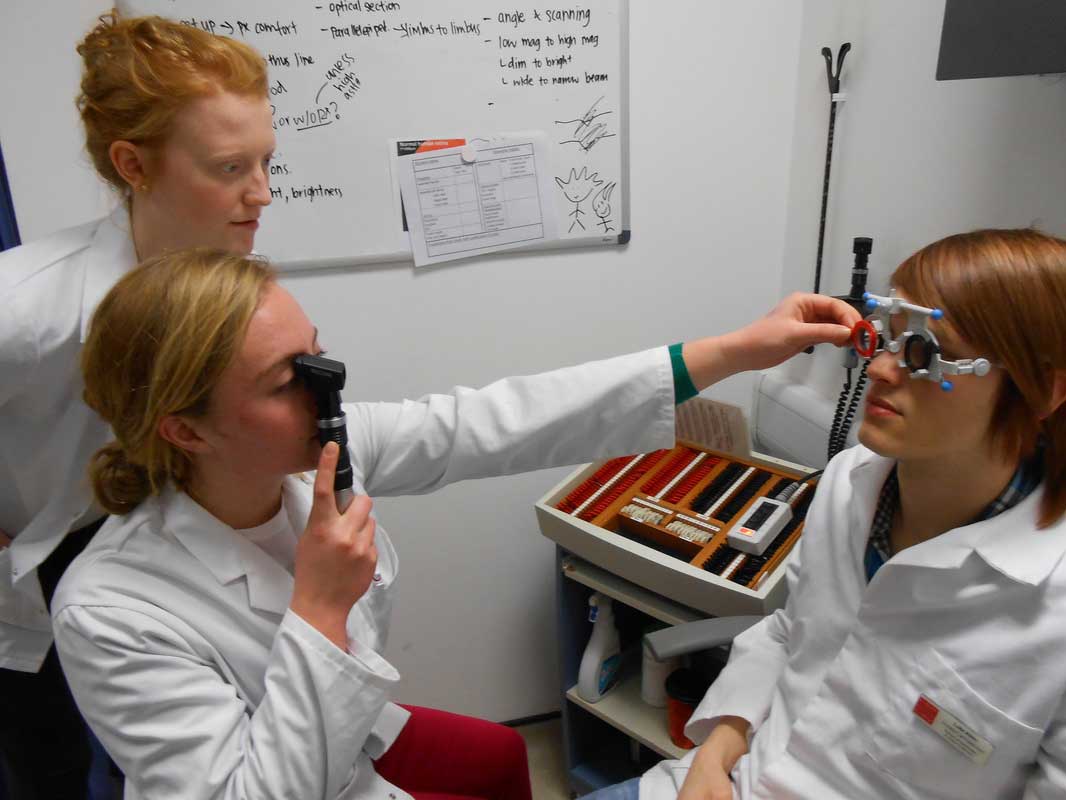
Retinoscopy (Ret) is a technique to obtain an objective measurement of the refractive error of a patient's eyes. The examiner uses a retinoscope to shine light into the patient's eye and observes the reflection (reflex) off the patient's retina. While moving the streak or spot of light across the pupil the examiner observes the relative movement of the reflex then uses a phoropter or manually places lenses over the eye (using a trial frame and trial lenses) to "neutralize" the reflex. Static retinoscopy is a type of retinoscopy used in determining a patient's refractive error. It relies on Foucault's principle, which states that the examiner should simulate optical infinity to obtain the correct refractive power. Hence, a power corresponding to the working distance is subtracted from the gross retinoscopy value to give the patient's refractive condition, the working distance lens being one which has a focal length of the examiner's distance from the patient (e.g. +1.50 dioptre lens for a 67 cm working distance). Myopes display an "against" reflex, which means that the direction of movement of light observed from the retina is a different direction to that in which the light beam is swept. Hyperopes, on the other hand, display a "with" movement, which means that the direction of movement of light observed from the retina is the same as that in which the light beam is swept. Static retinoscopy is performed when the patient has relaxed accommodative status. This can be obtained by the patient viewing a distance target or by the use of cycloplegic drugs (where, for example, a child's lack of reliable fixation of the target can lead to fluctuations in accommodation and thus the results obtained). Dynamic retinoscopy is performed when the patient has active accommodation from viewing a near target. Retinoscopy is particularly useful in prescribing corrective lenses for patients who are unable to undergo a subjective refraction that requires a judgement and response from the patient (such as children or those with severe intellectual disabilities or communication problems). In most tests however, it is used as a basis for further refinement by subjective refraction. It is also used to evaluate accommodative ability of the eye and detect latent hyperopia.
Article #3 : College of Optometrists
3-March-2015

The College of Optometrists is the professional, scientific and examining body for optometry in the United Kingdom, working for the public benefit. After the founding of the British Optical Association (BOA) in 1895, several more professional bodies were formed for the development of British optometry and by 1958 only four were in evidence authorised to conduct examinations and award professional qualifications statutorily approved by the General Optical Council. In 1962 the Institute of Optical Science (tracing its history to 1905) merged with the BOA thus leaving only three approved professional organisations for British optometry. The creation of a new professional body in the form of a Royal College for optometrists was suggested in 1972 in a letter published by Rishi Agarwal. The College was established in 1980 by three separate bodies, the former British Optical Association founded in 1895 and the Scottish Association of Opticians tracing its history to 1903 (both of which were disbanded in 1980) and the Worshipful Company of Spectacle Makers (incorporated by a Royal Charter in 1629 during the reign of King Charles I) which surrendered its examining function to the new College. In 1980 the title British College of Ophthalmic Opticians (Optometrists) was adopted. In 1987 the title was changed to British College of Optometrists and in 1995 the title College of Optometrists was adopted.